You are not imagining it.Your dollar is being quietly weakened.
A plain-language field guide that shows what inflation is, what it isn't, and who is responsible every time — without jargon, panic, or partisan noise.
- Understand the difference between rising prices and real inflation.
- Learn why savers and retirees feel the pain first.
- See through the usual excuses: greed, supply chains, and party politics.
- Explain the mechanism clearly to anyone at the dinner table.
Instant digital access · Educational guide · Not financial advice
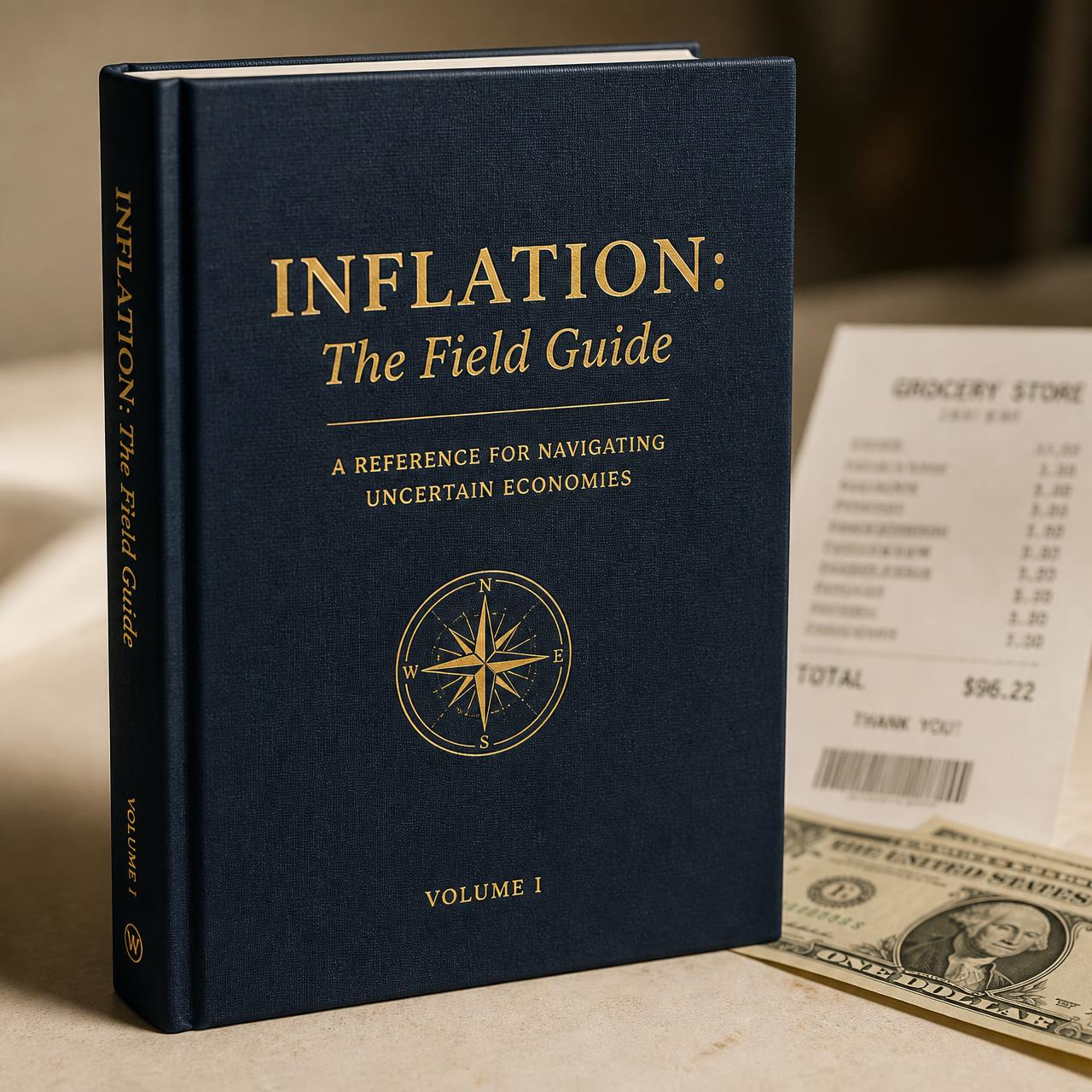
"Sound money. Clear thinking. No apologies."
The receipt feels wrong because something is wrong.
You worked. You saved. You planned. You did what responsible people were told to do. But the dollar did not hold up its end.
Every week, the number at the bottom of the receipt is a little higher. Every year, the retirement statement buys a little less than it says. And every headline that tries to explain it feels like it is missing something underneath.
- The grocery bill that keeps rising.
- The savings account that silently loses power.
- The retirement plan that no longer feels secure.
- The headlines that never quite explain the real cause.

If you misunderstand inflation, you keep blaming the symptom.
Most public explanations focus on what you can see. But the visible cause is rarely the real one. And while attention stays fixed on the symptom, the mechanism underneath keeps running — quietly, day after day, on the same schedule.
- · Higher prices at the register
- · Greedy corporations
- · Broken supply chains
- · The other political party
- · How new money is created
- · Who receives it first
- · Who pays for it last
- · Why inflation is a transfer
There is a clearer way to see it.
Inflation is not too complicated for you. It was just explained badly. Once you separate the symptom from the cause, the whole picture rearranges itself.
Price Inflation
- · What you see at the register
- · Rising prices on the shelf
- · The checkout pain
- · The wave on the surface
Monetary Inflation
- · What happens underneath
- · Expansion of the money supply
- · The mechanism, not the mood
- · The tide beneath the waves
Meet the Inflation X-Ray.
A simple diagnostic lens for seeing beneath every inflation headline. Five questions. One clear picture. Every time.
Is this price inflation or monetary inflation?
Is this the symptom or the cause?
Is this a wave — or the tide?
Who received the new money first?
Is this being described as weather when it was actually policy?
"A thing that can be named can no longer rob you in the dark."
Introducing Inflation: The Field Guide.
What It Is, What It Isn't, and Who's Responsible Every Time.
A plain-language guide for people who want to understand the mechanism behind inflation — without academic jargon, financial panic, or partisan blame.
It is written for intelligent readers who have lived through the consequences and want the explanation they should have been given years ago.
What you'll be able to see after reading.
See the real difference between rising prices and monetary inflation.
Explain why monetary inflation quietly punishes savers and retirees.
Recognize why 'corporate greed' is an incomplete explanation.
Tell the difference between supply-chain waves and the monetary tide.
Read economic headlines with sharper, more skeptical eyes.
Explain inflation at the dinner table without sounding partisan.
Inside the field guide.
Structured in three parts, with a working glossary, field tests, and plain-language examples designed to be read once and used for years.
What It Is
- · The Split — price inflation vs. monetary inflation
- · Where Money Comes From — how new dollars are created
- · The Silent Thief — why timing decides who gains and who loses
What It Isn't
- · It Isn't Greed
- · It Isn't the Supply Chain
- · It Isn't Just One Party
Who's Responsible Every Time
- · Inflation as Policy, Not Weather
- · 1971 and the End of the Monetary Chain
- · The Field Guide in Your Pocket

Fig. 1 — The dollar, over time.
The clarity you'll get, in one paragraph.
"Inflation means prices are going up."
"Rising prices are the symptom. Monetary expansion is the cause."
When more dollars are created while the amount of real goods does not rise at the same pace, each existing dollar buys less. Prices rise later, as the visible effect.
Supply chain problems are waves. Monetary inflation is the tide.
Built for readers who want mechanism, not noise.
This is not investment content. It is not a partisan rant. It is a working reference for clear thinking.
- Grounded in the sound-money tradition associated with Ludwig von Mises.
- Written in plain English for intelligent non-economists.
- Designed to make the mechanism clear — not to sell financial products.
- Educational content only. Not investment, legal, or tax advice.
- Calm, structured, and field-tested through clear explanations.
No economics degree required.
You don't need to be. The guide was written to remove jargon and explain the mechanism in clear, ordinary language.
It explains why inflation is structural, not just partisan. It's about incentives, institutions, and monetary mechanisms.
No. It won't tell you what to buy, sell, or invest in. It gives you clarity about what is happening to the dollar.
It's a focused field guide — structured, readable, and designed to give you a permanent lens for understanding inflation.
Designed to be read in one focused afternoon — and used for years.
Not for people looking for trading tips, investment advice, or partisan entertainment.
The 7-Day Clarity Guarantee
Read the guide. If it does not make inflation clearer, easier to explain, and less confusing — request a refund within 7 days. That's it.
Get the complete Inflation Clarity Kit.
- Inflation: The Field GuideThe core 3-part manual — What It Is, What It Isn't, Who's Responsible.
- The Inflation X-Ray ChecklistThe 5-question lens, printable and pocket-sized.
- The Silent Thief GlossaryPlain-language definitions of every term that matters.
- The Dinner Table Inflation ScriptHow to explain it clearly — without sounding partisan or paranoid.
- The Printable Field CardOne page. Fold it. Keep it. Use it.
- Instant Digital AccessDelivered as a PDF, immediately after purchase.
- 7-Day Clarity GuaranteeRefund window if it doesn't make things clearer.
Less than a dinner out — for a framework that changes how you read every inflation headline from now on.
Instant access · Educational · 7-day guarantee
Questions before you decide.
Short, honest answers to what most readers ask before buying.
Stop guessing what is happening to your dollar.
See the mechanism clearly. Understand the difference between symptom and cause. Name what has been quietly working against you.
Instant access · Plain English · Educational only · 7-day guarantee